Tumbuh dariTanah Sendiri
Grown from its own soil. Lembah Raden did not come from a business plan or a wellness trend. It came from a valley, a river, and the people who have always called this place home.
There is a valley in Tabanan
that most people never find.
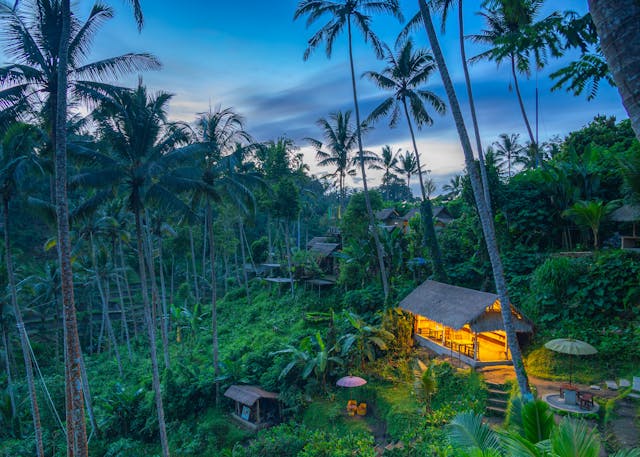
The road narrows just past the main junction at Marga. The rice fields open wide on both sides, and somewhere between the last warungs and the treeline, the noise of Bali — the traffic, the sellers, the crowds — simply stops. What replaces it is the sound of a river. A real one, running cold and clear through the base of a lush valley.
"This place didn't need to become anything. It was already everything — we just needed to open the door."
That is Desa Raden. And for the people who live here — farmers, healers, cooks, and ceremony keepers — this valley has never been hidden. It has been home. Lembah Raden grew out of a simple question: how do we invite people in, without losing what makes this place what it is?
Every program taught here was already being practised here. Every ingredient used was already being grown here. We did not bring wellness to this valley. The valley already had it. What we built was simply a doorway.
Far enough to
truly arrive
Tabanan is the quiet regency — the one without a famous beach or a famous road. What it has instead is real rice fields, real forest, and real village life happening at its own pace. Desa Raden sits in the interior, tucked between hills covered in jungle and terraced fields.
Three things the valley
teaches every guest
The Balinese call it Tri Hita Karana — the three causes of well-being. We don't put it on a poster. We let guests discover it themselves, through what they do here.
Harmony with the Divine
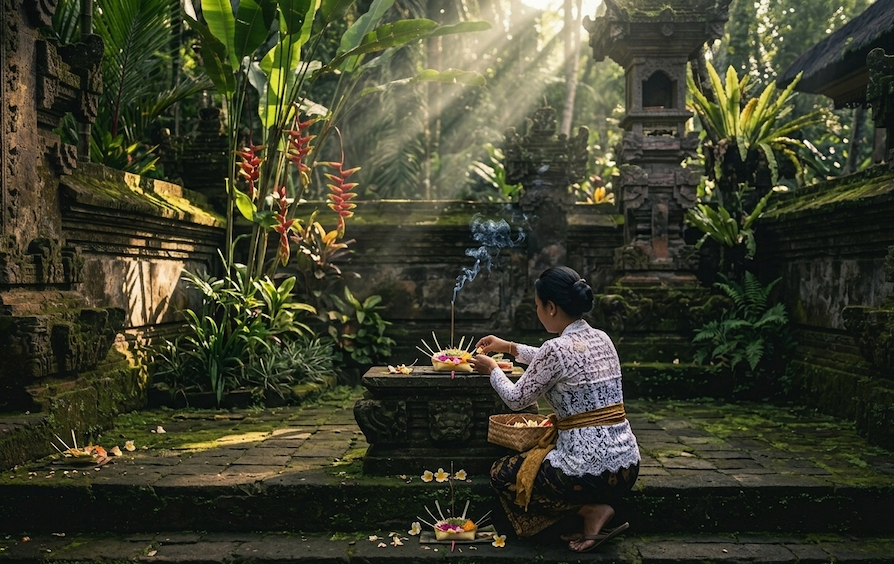
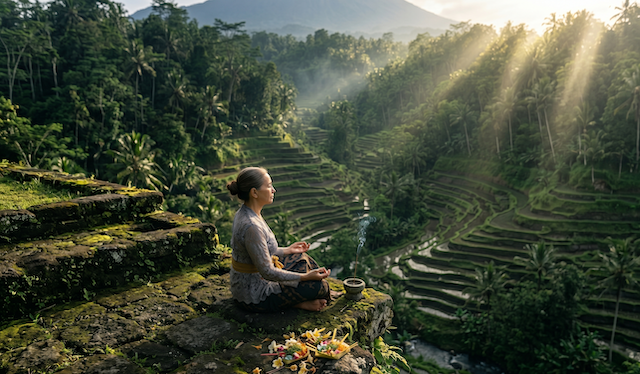
Every morning in Desa Raden, before the garden is tended or the kitchen is lit, the women of the village make canang sari. This is not ceremony for special occasions — it is daily maintenance of a relationship with something larger. When guests join the purification ritual, they are not observing. They are being welcomed into a practice.
Harmony with Each Other
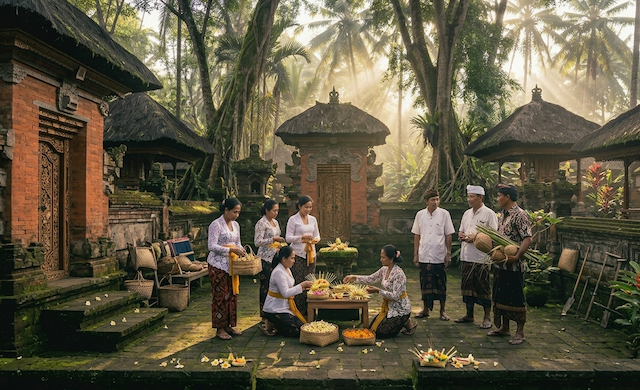
The guides, cooks, healers, and farmers who make up our team are not employees hired for a job. They are neighbours who chose to open their knowledge to the world. Every time a guest sits at the table, they are sitting with a family, not a service.
Harmony with the Natural World
The organic garden is not a feature — it is the curriculum. The river's sound during yoga is not background ambience — it is the practice itself. Letting it in. Becoming porous to the place you are in. That is what this valley has always offered the people who live here.
It is not about us.
It is about them.
The community of Desa Raden created this — with their knowledge, their hands, their daily practices, and their willingness to share.
Our guides grew up in the valley. They lead not from a script, but from a lifetime of walking this land.
The women who run the kitchen cook from the same intuition that has fed families in this valley for generations.
Carrying Usada Bali — ancient Balinese herbal knowledge — that predates any textbook. A walk with them through the garden is a lesson no school offers.
The purification ceremony is not performed for guests. It is performed because the community believes in it. Guests are simply welcomed in.
The hardest thing about building Lembah Raden was the ongoing question of balance: how do you invite the outside world into a living community without that community becoming a performance of itself?
The answer was simple: stay grounded in what is real. Grow your own food. Cook it the way it has always been cooked. Teach only what you genuinely know. Welcome guests as people who are temporarily joining daily life. Keep the ceremonies sacred. Keep the river clean.
The values that hold us together
Working together for collective well-being — at the root of how every program, meal, and gathering is organised here.
The Balinese concept of spiritual presence — what gives a ceremony or teaching its genuine quality. It cannot be manufactured.
Why guests here are welcomed not as clients, but as extensions of the community itself.
The tradition of sharing food as gratitude and blessing. Every meal at Lembah Raden is offered, not served.
Six things the village
has always known
These are not lessons invented for a wellness retreat. They are the living knowledge of Desa Raden — practised daily, passed between generations, and shared with every guest.
Long before pharmacies, Balinese families maintained their health through jamu — blends of turmeric, ginger, galangal, lemongrass, each with a specific role in the body.
Balinese traditional architecture is not aesthetic — it is cosmological. The orientation of a gate, the placement of a shrine — all follow the spiritual principles of Asta Kosali.
In this valley, pranayama is the practice of becoming porous to your surroundings — letting the river's sound in, letting the forest's stillness settle.
The ancient Balinese irrigation system — Subak — is built on cooperative water management. Our garden follows the same principle: no plot is separate from the whole.
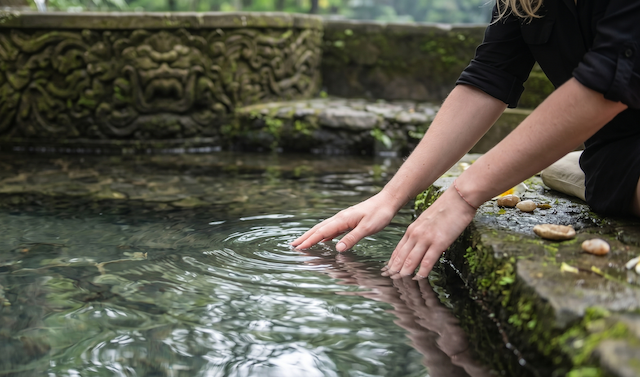
When guests participate in Melukat, they are not experiencing a cultural simulation. They are entering a relationship with a place that has been holding that intention for a very long time.
You harvest what you will cook. You cook with someone who has been doing this all their life. Then you eat together. That is the cooking class at Lembah Raden.
Kecamatan Marga
Kabupaten Tabanan
Bali, Indonesia
Where Heritage
Meets Harmony
Like the flow of the river and the stillness of the air — we are honoured to be part of something that is genuinely healing. A space where nature and humanity can finally grow as one.
If this story has moved something in you — a curiosity, a longing — come and see it for yourself. The valley is not going anywhere. Neither are we.
Come Visit →